Date source not yet attached to this catalogue record.
The Time Slider
One date. A world of histories.
Guided journeys
See how the stories connect.
A few memorable stops, a wider world at each date, and a chance to test what you remember.
Food, homes and monuments
Compare New Guinea gardens, Gunditjmara channels, Jōmon homes and American earthworks.
Start journey · 6 stopsRights, resistance and independence
Connect Haiti, Waitangi, Japan, women’s votes, Adwa, Bandung and Ghana on one axis.
Start journey · 7 stopsBefore the first cities
Follow settlements into several urban worlds, from Anatolia to Peru and the Indus.
Start journey · 6 stopsAfrica’s connected kingdoms
Move from the Nile and Red Sea to southern Africa, the Swahili coast and Mali.
Start journey · 6 stopsHuman calendar: a linear date axis, separate from geological and cosmic age estimates.
Drag left / right to pan
Focused window: 401 BCE – 600 CE. Arrow keys step one year; Shift + arrow steps ten. 1 BCE is followed by 1 CE. Earlier / deep history
Stars highlight selected learning anchors; all dated subjects remain available.
Explore a moment
The world in 100 CE.
See where the stories belong. Pick a place, follow a thread, then look across the same centuries.
Solid markers overlap the year. Hollow markers are nearby, when enabled. Numbers group nearby stories.
Present-day coastlines for orientation; markers locate sites or labelled regions, not historical borders. Pacific stories can appear on both sides of this world map. Natural Earth · public domain
Read selected story: Aksum: a kingdom linked to the Red Sea ↓5 source-linked mapped records in this selection. Counts describe this catalogue, not historical population or importance. 6 other records at this year have no supported map position; they remain available in the dated catalogue.
Browse every mapped story · 5
See the overlap.
One linear BCE/CE axis for every continent. Bars show selected phases; the gold line is 100 CE. Dashed edges mean approximate dates.
Compare across all enabled regions and the chosen topic. Select a bar to explore its place and story while keeping this year.
Selected source-linked stories
401 BCE600 CE
Africa
3 more mapped stories in this window
Asia
3 more mapped stories in this window
Europe
No mapped story in this window and selection. Explore another date or broaden the area/topic.
North America
1 more mapped story in this window
South America
Oceania & Pacific
No mapped story in this window and selection. Explore another date or broaden the area/topic.
Revisit saved connections
Saves one source-linked example per represented continent. Saved on this device.
Europe
At this time · catalogue date overlaps
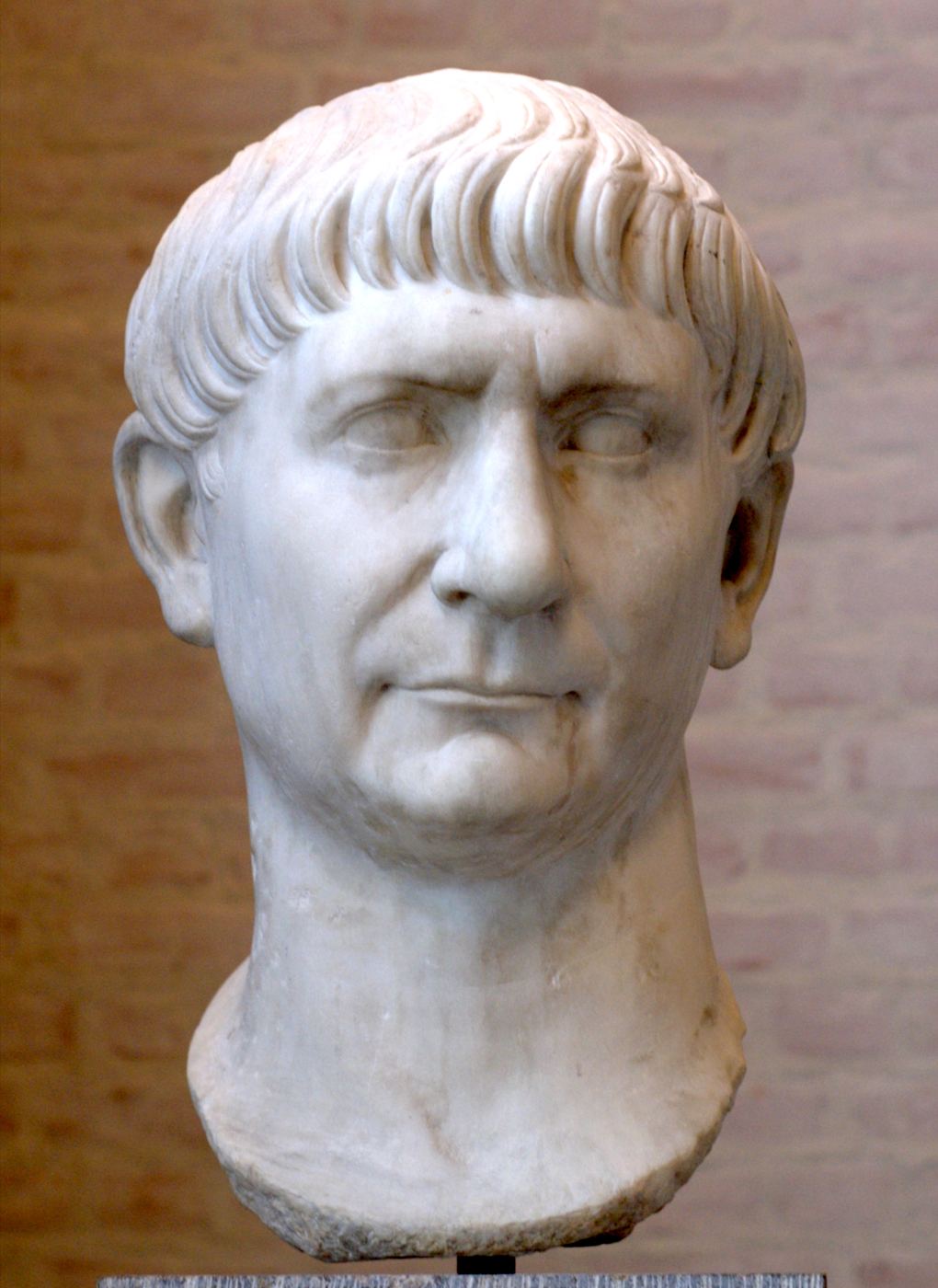
53 CE – 117 CE
figure
The Spanish-born soldier-emperor who pushed Rome to its greatest territorial extent, conquered Dacia in two grinding campaigns, and left the capital transformed in marble and monumental stone.
Lifetime
Date source not yet attached to this catalogue record.

76 CE – 138 CE
figure
The restless, Greece-obsessed emperor who spent half his reign travelling the empire, fortified its edges from Britain to Syria, rebuilt the Pantheon, and mourned his drowned lover Antinous with the grief of a god.
Lifetime
Date source not yet attached to this catalogue record.
Nearby in time · within ±50 years

121 CE – 180 CE
figure
The last of Rome's 'Five Good Emperors' — a Stoic philosopher-king who fought a frontier war for the last decade of his life and wrote a private journal of moral self-correction that has never gone out of print.
Lifetime
Date source not yet attached to this catalogue record.
Editorial fallback · snapshot c. 100 CE, not the selected year
Roman Empire at Peak
Trajan extending to Dacia and Mesopotamia. The Pantheon is being built. Latin literature in its Silver Age. Population of Rome over 1 million.
Broad historical snapshot; individual claims are not yet source-linked.
Middle East & Africa
At this time · catalogue date overlaps
Kush developed royal and religious centres along the Nile south of Egypt. Meroë’s pyramids and monuments record an African kingdom with its own traditions.
Selected Kushite kingdom and royal-centre period
Rounded eighth-century BCE to fourth-century CE bounds for the selected phase; Kush has earlier history.
UNESCO · Meroë and the Kingdom of KushAksum connected the northern Ethiopian and Eritrean highlands with Red Sea trade. Coins, monumental stelae and Christian institutions illuminate different parts of its history.
Aksumite civilisation · first to eighth centuries CE
Century bounds describe a cultural period, not exact accession or collapse dates.
The Met · Aksumite civilisationNearby in time · within ±50 years
No nearby records loaded.
Editorial fallback · snapshot c. 100 CE, not the selected year
Parthia · Kushan · Aksum
The Parthians on Rome's eastern flank. Aksum in Ethiopia trading across the Red Sea. Roman governors in Judaea after the destruction of the Temple.
Broad historical snapshot; individual claims are not yet source-linked.
Asia
At this time · catalogue date overlaps
Routes across Central Asia carried goods, people and religious ideas. This was a changing network of journeys and settlements, rather than one road joining two fixed endpoints.
Chang’an–Tianshan corridor · selected long span
A broad corridor history from the second century BCE to the sixteenth century CE; routes changed throughout.
UNESCO · Silk Roads corridorDate source not yet attached to this catalogue record.
In Gandhara, Buddhist art developed amid connections between South Asia, Central Asia and Mediterranean traditions. Kushan rule was one part of this wider cultural setting.
Gandhara under Kushan rulers · early centuries CE
Rounded first–third century CE phase, distinct from earlier migrations and later Buddhist art.
The Met · The Kushan EmpireNearby in time · within ±50 years
No nearby records loaded.
Editorial fallback · snapshot c. 100 CE, not the selected year
Han China · Kushans
Han China at its territorial peak; paper has just been invented. Kushan empire bridges Central Asia and northern India. Buddhism spreading along the Silk Road.
Broad historical snapshot; individual claims are not yet source-linked.
Americas
At this time · catalogue date overlaps
Tikal’s temples, palaces, inscriptions, reservoirs and surrounding settlements reveal a major Maya urban world. Its city history spans the BCE/CE boundary; Maya communities and cultures continued beyond this urban phase.
Selected Preclassic-to-Classic urban history
c. 600 BCE–900 CE follows UNESCO’s selected archaeological period, not the entire history of Maya peoples.
UNESCO · TikalTeotihuacan developed a large urban landscape with pyramids, avenues and residential compounds. It belongs to an earlier history than the later Aztec Empire.
City and monumental development · first to seventh centuries CE
Rounded first–seventh century city-development span; distinct from a narrower peak-period comparison.
UNESCO · TeotihuacanNearby in time · within ±50 years
No nearby records loaded.
Editorial fallback · snapshot c. 100 CE, not the selected year
Maya Emerging · Teotihuacan
The Maya pre-classic transitioning to classic — first stelae and dated inscriptions. Teotihuacan is becoming the great city of central Mexico. Moche on the Peruvian coast.
Broad historical snapshot; individual claims are not yet source-linked.
Oceania & Pacific
At this time · catalogue date overlaps
Catalogue gap: no dated record loaded for this region at the selected year. This does not mean nothing happened.
Nearby in time · within ±50 years
No nearby records loaded.
Global / region not catalogued
At this time · catalogue date overlaps
Catalogue gap: no dated record loaded for this region at the selected year. This does not mean nothing happened.
Nearby in time · within ±50 years
Rome reaches its greatest extent under Trajan.
Date source not yet attached to this catalogue record.
Era context · dated catalogue bounds
Periods are regional conventions, not universal stages; overlapping eras may both apply.
800 BCE – 500 CE
Greece, Rome, Persia, Han China, Mauryan India — the classical world.
Date source not yet attached to this catalogue record.
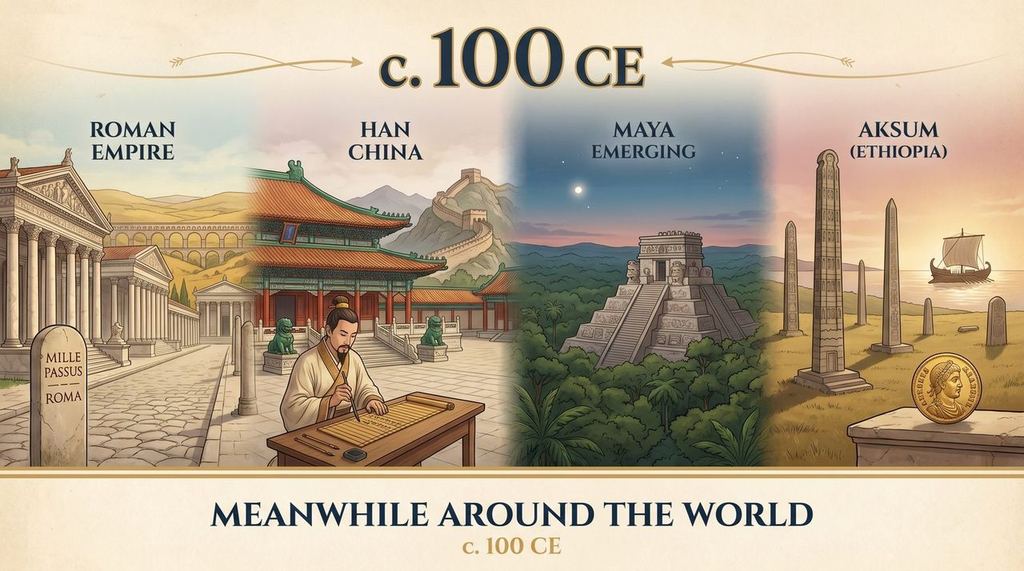
Editorial snapshot · c. 100 CE
Empires of Marble & Silk
Fallback text and illustration below refer to c. 100 CE, not the selected year. This is an editorial illustration, not a historical photograph.
The Pax Romana and the Han at the same moment. The Silk Road carries goods, plagues, and ideas across Eurasia. Christianity is a tiny Jewish sect.
The cultural library
Compare history
Before, after, or at the same time?
Pin two to four subjects. Your pins stay with you as you navigate; the URL restores this comparison.
Replace pins with a preset:
0 of 4 subjects pinned.
Choose a preset or search to start comparing.