Richard Wagner was born on 22 May 1813 in Leipzig, the ninth child of a police actuary who died six months later. He was raised in a theatrical household — his stepfather Ludwig Geyer was an actor and playwright — and educated in Dresden and Leipzig, where he absorbed Beethoven's symphonies and Shakespeare's plays with equal ferocity. By his mid-twenties he had written his first substantial operas, Rienzi and Der fliegende Holländer, while working as a conductor in Riga, Königsberg, and finally Dresden, where he held the prestigious post of Hofkapellmeister from 1843. Dresden, however, turned him into a revolutionary: Wagner participated in the failed May Uprising of 1849 alongside Mikhail Bakunin, manning barricades against Prussian troops. A warrant was issued for his arrest, and he fled to Zurich, beginning twelve years of Swiss exile. In exile, Wagner wrote the prose works that theorised his new concept of the Gesamtkunstwerk — the total work of art fusing poetry, music, staging, and gesture into an indivisible whole. He also sketched the complete text of Der Ring des Nibelungen, a four-opera cycle drawn from Norse and German mythology. Composition of the Ring began in earnest in 1853. The first two parts, Das Rheingold and Die Walküre, were drafted in the 1850s, but Wagner set the cycle aside to write Tristan und Isolde (premiered Munich, 10 June 1865), whose opening chord — a suspended dissonance that refuses orthodox resolution — is the single most discussed moment in the history of Western tonality. Die Meistersinger von Nürnberg followed in 1868, a warm comedy and the only major work of his mature period set in the human world rather than myth. The Ring was completed in 1874, twenty-six years after its conception. Its premiere at the new Festspielhaus in Bayreuth on 13–17 August 1876 was attended by Kaiser Wilhelm I, Emperor Dom Pedro II of Brazil, Liszt, Bruckner, Grieg, Tchaikovsky, and Nietzsche. Wagner had designed every aspect of the theatre himself: raked seating, a sunken orchestra pit hiding the conductor from the audience, and darkened auditorium — all innovations aimed at abolishing the gap between spectator and drama. The Bayreuth Festspielhaus remains in operation today. His personal life was as turbulent as his art: a first marriage to actress Minna Planer ended in permanent separation; a long affair with Mathilde Wesendonck, wife of his Zurich patron, fed directly into Tristan; and from 1864 he relied on the obsessive patronage of the young Bavarian king Ludwig II, who subsidised his Munich productions and private villas. His second wife, Cosima — illegitimate daughter of Liszt, formerly married to conductor Hans von Bülow — became his closest collaborator and the keeper of his legacy after his death. Their son Siegfried was born in 1869. Wagner completed his final opera, Parsifal — a sombre mystery play about redemption and the Holy Grail — at Bayreuth in 1882. He died of a heart attack in the Palazzo Vendramin-Calergi, Venice, on 13 February 1883, aged sixty-nine. He was buried in the garden of his Bayreuth villa Wahnfried.
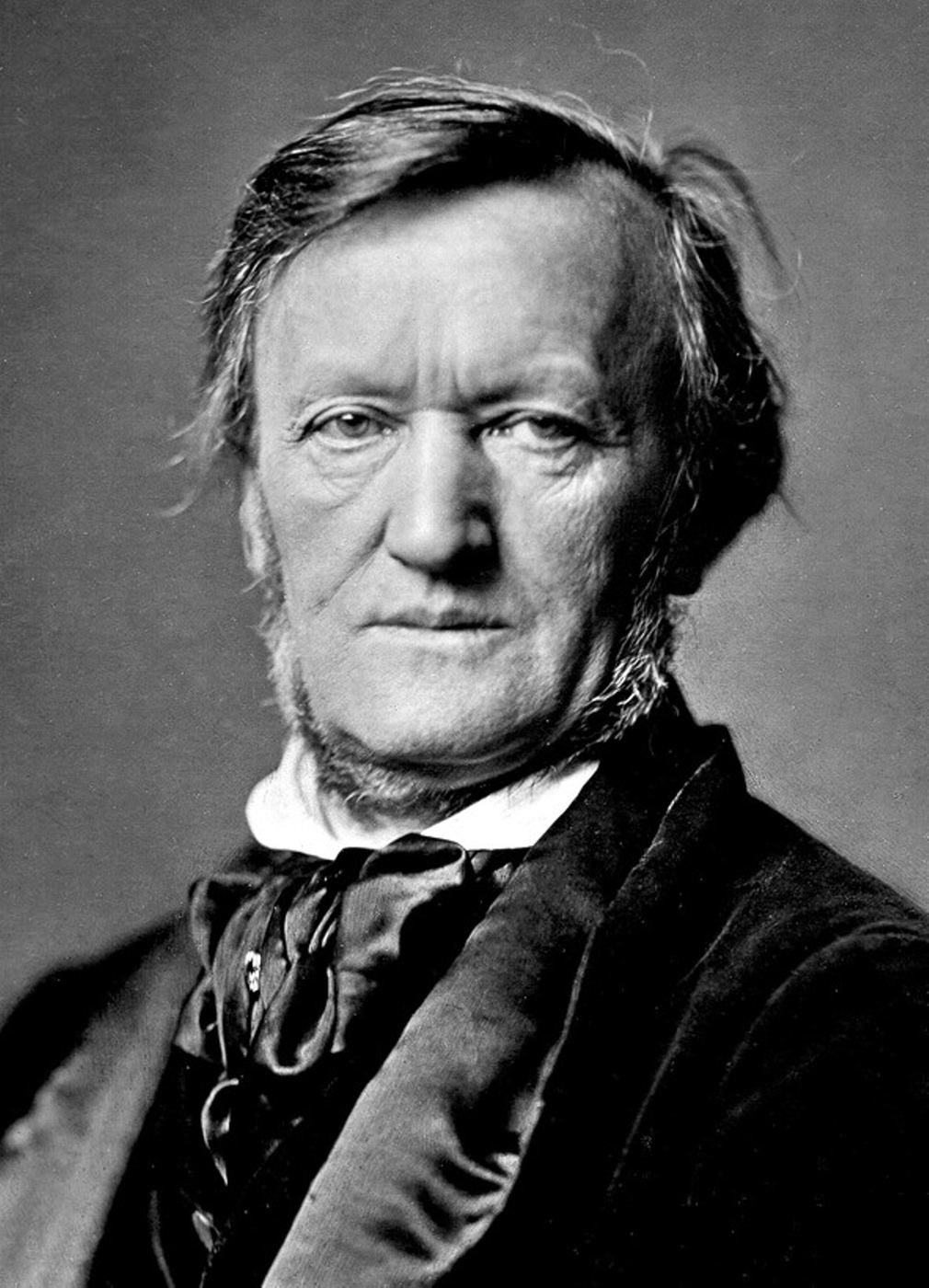
All Figures
Composer of the Ring Cycle · Founder of the Bayreuth Festspielhaus
Richard Wagner
1,813 CE – 1,883 CE
The Leipzig-born revolutionary who reinvented opera as music-drama, built his own festival theatre at Bayreuth, and changed the harmonic language of Western music for a century.
Lifetime
Date source not yet attached to this catalogue record.
Deeper Dive
Unlock Richard Wagner's full archive.
Notable works, life timeline, places lived, key quotes, reading list — all 158 figures' deep dives open with Epoch+.