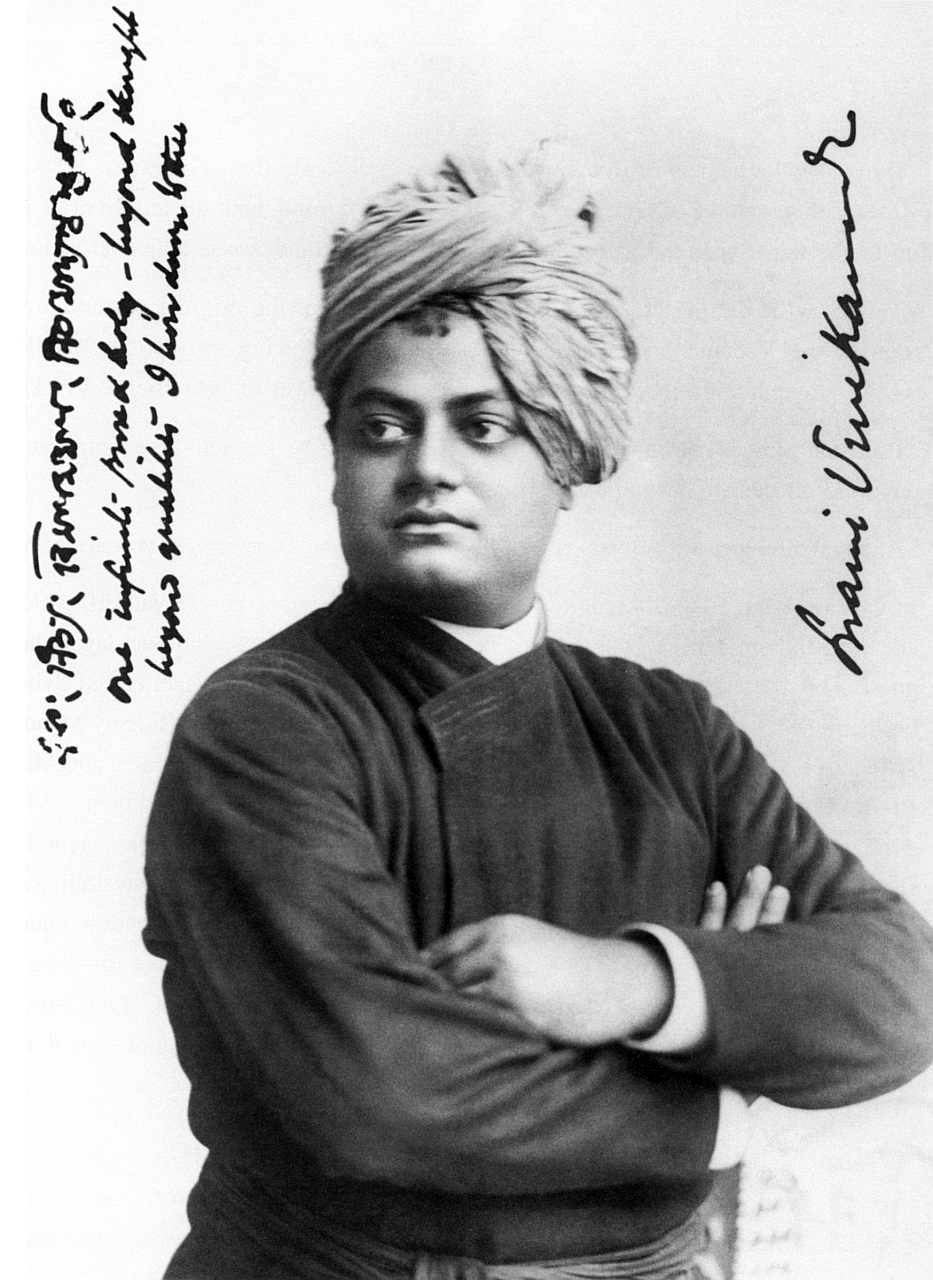
Swami Vivekananda was born Narendranath Datta on 12 January 1863 in Calcutta, to a prosperous Kayastha family. His father Vishwanath was a successful attorney with a rationalist temperament; his mother Bhuvaneshwari Devi was deeply religious. From childhood Narendranath combined fierce intellectual curiosity with a capacity for meditation that struck observers as unusual. He studied at Scottish Church College and Presidency College in Calcutta, graduating with a degree in the Western humanities while simultaneously devouring Hindu scripture, Western philosophy, and the writings of Herbert Spencer and John Stuart Mill. In 1881 he met Ramakrishna Paramahamsa, the mystic priest of the Dakshineswar Kali Temple outside Calcutta. The encounter transformed him. Ramakrishna was illiterate, ecstatic, and convinced that all religions lead to the same divine ground; Vivekananda was skeptical, educated, and combative. Over five years of near-daily contact, Ramakrishna drew out of his young disciple an experiential certainty about God that rational argument had never supplied. When Ramakrishna died of throat cancer in August 1886, Vivekananda gathered the monastic disciples and established the first Ramakrishna Math at Baranagar, a dilapidated house north of Calcutta. For the next six years he traveled incognito across India as a wandering monk, moving from Punjab to Kerala, from Rajasthan to Tamil Nadu, sleeping in temples and noble houses, witnessing at first hand the poverty and social immobility of a colonized country. At Kanyakumari at the southern tip of India, sitting on a rock in the sea in December 1892, he reportedly meditated for three days on the condition of his nation and resolved to carry Vedanta to the West to raise money and moral support for India's poor. He traveled to Chicago and on 11 September 1893, at the Parliament of the World's Religions, rose to address an audience of thousands. His opening words — 'Sisters and brothers of America' — triggered a two-minute standing ovation. His address arguing that all religions are true paths to the same ultimate reality electrified Western audiences hungry for alternatives to sectarian Christianity. He spent the next three years lecturing and teaching across America and Europe, establishing Vedanta Societies in New York, London, and San Francisco, and attracting followers including the Irish-American Margaret Noble (Sister Nivedita). His published lectures — Raja Yoga (1896), Jnana Yoga (1899), Karma Yoga (1896), and Bhakti Yoga (1896) — remain standard texts of Vedantic philosophy in English. He returned to India in 1897 to a hero's welcome. In May of that year he founded the Ramakrishna Mission in Calcutta, combining monastic life with the active relief of suffering: running schools, hospitals, and disaster-relief operations. He built Belur Math on the west bank of the Hooghly as the Mission's headquarters and architectural expression of his conviction that all religions are harmonious. He made a second, shorter visit to the West in 1899–1900, attending the Paris Exposition and teaching in California. His health deteriorated throughout this period — he suffered from diabetes, kidney disease, and exhaustion. On 4 July 1902, at the age of thirty-nine, he died at Belur Math, telling his disciples he would not live to forty, a prediction he had made years earlier.
All Figures
Hindu Monk · Founder of Ramakrishna Mission
Swami Vivekananda
1,863 CE – 1,902 CE
The Hindu monk who carried Vedanta philosophy to the West at the 1893 Parliament of the World's Religions and founded the Ramakrishna Mission to combine spiritual practice with social service.
Lifetime
Date source not yet attached to this catalogue record.
Deeper Dive
Unlock Swami Vivekananda's full archive.
Notable works, life timeline, places lived, key quotes, reading list — all 158 figures' deep dives open with Epoch+.