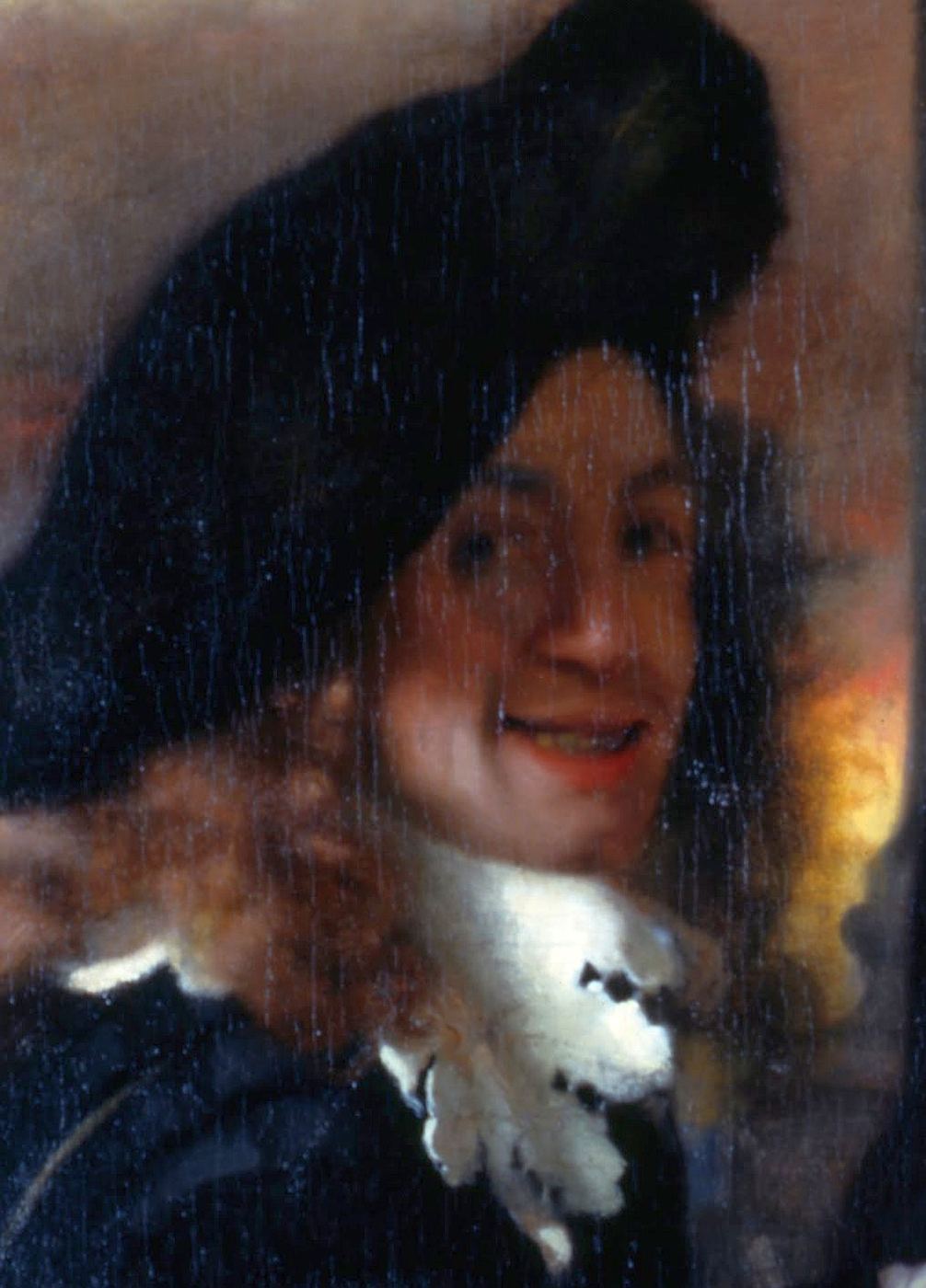
Johannes Vermeer was baptised on 31 October 1632 in Delft, in the Dutch Republic, the son of a silk weaver and art dealer named Reynier Jansz, who also traded paintings under the name Vos. He spent his entire working life within that single city, in streets he could cross in ten minutes. In April 1653 he married Catharina Bolnes, a Catholic woman of higher social standing; the match required his conversion and the couple eventually had fifteen children, eleven of whom survived infancy. His mother-in-law Maria Thins, a shrewd woman of property, almost certainly helped finance the household. That same year Vermeer registered with Delft's Guild of Saint Luke as a master painter, and he later served two terms as headman of the guild, in 1662 and again in 1663 — a mark of professional standing among peers who knew his work well. He almost certainly trained under Carel Fabritius, the Rembrandt pupil who had settled in Delft and was killed in the catastrophic powder-magazine explosion of 12 October 1654, which levelled a quarter of the city. Only about 36 paintings are now attributed to Vermeer with any confidence — a body so small it suggests either extraordinary slowness, extraordinary selectiveness, or losses we cannot reconstruct. X-ray and dendrochronological studies of his panels and canvases confirm no clear chronology; virtually no drawings survive either. The works themselves are relentlessly domestic in subject: women reading letters by a window, pouring milk from an earthenware jug, weighing gold on a small balance, sitting for music lessons in a cool tiled room. Yet within those narrow interiors Vermeer achieved something no other painter had quite managed — a total account of how northern light, entering from the left through a leaded window, behaves as it crosses a tiled floor, strikes a linen collar, reflects off the glaze of a map, and pools in the shadow of a plaster wall. Scholars have debated for a century whether he used a camera obscura to project scenes onto a canvas surface; technical analysis, principally from Tim Jenison's 2013 investigation and David Hockney's earlier work, makes optical aids probable for at least some pictures, though the degree of dependency remains contested. Girl with a Pearl Earring (c.1665), now in the Mauritshuis in The Hague, became so iconic in the 20th century that it was dubbed the 'Mona Lisa of the North', though Vermeer himself gave it no title; it is a tronie — a study of a type rather than a named sitter — and it hung forgotten for two centuries before its current celebrity. Woman Holding a Balance (c.1664) at the National Gallery in Washington places a pregnant woman poised between the temporal world of gold and pearls on the table before her and the Last Judgment painted on the wall behind her — devotional meditation expressed as domestic scene. The Milkmaid (c.1657–58) at the Rijksmuseum Amsterdam is the definitive statement of his method: a servant woman pouring milk from a jug, the stream of liquid the precise focal point of the composition, bread crusts and a foot-warmer the only props. View of Delft (c.1660–61), which Marcel Proust called the most beautiful painting in the world, is one of only two surviving outdoor townscapes. The Art of Painting (c.1666–68), which Vermeer kept for himself throughout his life and which Catharina inherited, shows a painter — almost certainly Vermeer himself — at a large canvas, his model costumed as Clio, muse of history. His final years were catastrophic. The French invasion of the Dutch Republic in the Rampjaar (Disaster Year) of 1672 destroyed the art market; Vermeer died in December 1675, aged 43, leaving Catharina with eight children still at home and debts of over 1,000 guilders including bread money owed to a baker. She eventually surrendered The Art of Painting to that baker in partial settlement; it passed through several collections before entering the Kunsthistorisches Museum Vienna in 1813. Vermeer's reputation collapsed almost immediately after his death. He was not recovered as a significant artist until the French critic Théophile Thoré-Bürger published his pioneering three-part study in 1866, attributing some 66 works to the near-forgotten Delft master — a list later refined to around 36 — and effectively creating the modern Vermeer from archival dust.
All Figures
Dutch Golden Age painter · Master of light and domestic interior
Johannes Vermeer
1,632 CE – 1,675 CE
The Delft master who transformed a single room's afternoon light into perhaps the most quietly devastating body of painting in Western art — roughly 36 canvases, most of them unknown until two centuries after his death.
Lifetime
Date source not yet attached to this catalogue record.
Deeper Dive
Unlock Johannes Vermeer's full archive.
Notable works, life timeline, places lived, key quotes, reading list — all 158 figures' deep dives open with Epoch+.