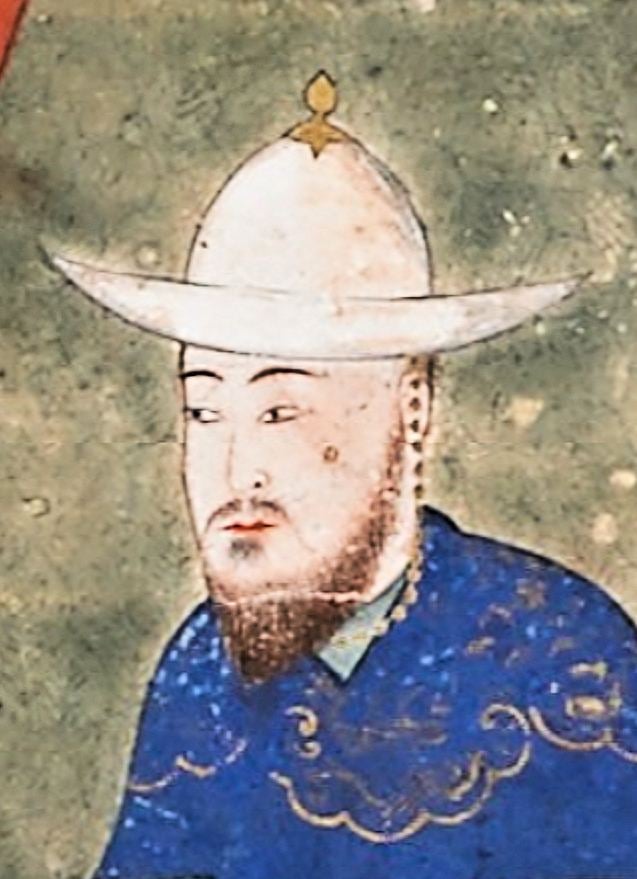
Ulugh Beg — born Mirza Muhammad Taraghay bin Shahrukh on 22 March 1394 in Sultaniyya, northwestern Persia — was the grandson of Timur and the most consequential astronomer of the fifteenth century anywhere in the world. His father Shah Rukh inherited the Timurid heartland after Timur's death in 1405 and ruled from Herat; in 1409, at the age of fifteen, Ulugh Beg was appointed governor of Samarkand and the province of Mawarannahr, which he would administer for the next four decades. He was not primarily a military man — several of his campaigns in Central Asia ended in defeat — but the combination of a stable court, a personal passion for mathematics and astronomy, and the resources of the Timurid state made Samarkand under his rule the most important center of exact science between the thirteenth-century Maragha Observatory and the European . As a boy he had visited the ruins of Maragha, built for Nasir al-Din al-Tusi under the Mongol Il-Khans in 1259, and the encounter defined his ambitions. Between 1420 and 1429 he built the Gurkhani Observatory on a hill north of Samarkand: a three-story cylindrical structure containing a colossal marble sextant — technically a 'Fakhr' sextant — whose arc ran forty meters underground along the meridian, oriented precisely north-south. The instrument's scale was calibrated to arcs of seconds. With this, and with the collaborating genius of Jamshid al-Kashi (who calculated pi to seventeen decimal places and invented the decimal fraction in its modern form) and Ali Qushji, Ulugh Beg's team undertook a systematic re-measurement of the entire sky. The Zij-i-Sultani — the Sultan's Astronomical Tables, completed around 1437 and dedicated to Ulugh Beg's own name — catalogued 1,018 stars with their coordinates, measured by direct observation rather than copied from Ptolemy or al-Sufi. The precision was extraordinary: his measurement of the length of the sidereal year was 365 days, 6 hours, 10 minutes, and 8 seconds — differing from the modern value by less than sixty seconds. His determination of the axial tilt of the earth came within two arc seconds of the true value. Tycho Brahe, working in Denmark 150 years later with arguably better instrumentation, did not materially improve on Ulugh Beg's stellar coordinates. Beyond the observatory, Ulugh Beg was an educator on a scale unusual for a ruling prince. He built three madrasas — the grandest on the Registan in Samarkand (completed 1420), one in Bukhara, and one in Gijduvan — that served as genuine institutions of scientific learning, not merely Quranic schools. He wrote a treatise on trigonometry and a history of the Mongols. He held informal lectures on mathematics for court officials. His political career, however, never matched his scientific one. He was a mediocre general and a poor judge of loyalty. When his father Shah Rukh died in 1447 and Ulugh Beg became sultan, the empire he inherited was already fracturing. His son Abd al-Latif, backed by religious conservatives who resented the observatory and the rational curriculum at the madrasas, raised a rebellion. Ulugh Beg was deposed, stripped of authority, and sent on a pilgrimage — then arrested on the road and beheaded on 27 October 1449, at the age of fifty-five. His observatory was dismantled within a generation by the same forces that killed him. The massive underground sextant trench was lost under the sands and not rediscovered until the Russian archaeologist Vyatkin excavated the hill in 1908. His star catalogue, however, survived: brought to Oxford by John Greaves in the seventeenth century, it was published in 1665 and became a standard reference for European astronomers including Flamsteed and Halley. Ulugh Beg's lunar crater, the asteroid 2439 Ulugbek, and the Mirzo Ulugbek district of Tashkent all bear his name. He remains the only sovereign in history to have made discoveries of the first rank in exact science — a king who spent more time at his sextant than at his council table, and who paid for it with his life.
All Figures
Timurid Astronomer-King · Builder of the Samarkand Observatory
Ulugh Beg
1,394 CE – 1,449 CE
Timur's grandson who ruled Samarkand and built the finest observatory of the pre-telescope world, producing a star catalogue accurate enough to confirm the precession of the equinoxes.
Lifetime
Date source not yet attached to this catalogue record.
Deeper Dive
Unlock Ulugh Beg's full archive.
Notable works, life timeline, places lived, key quotes, reading list — all 158 figures' deep dives open with Epoch+.