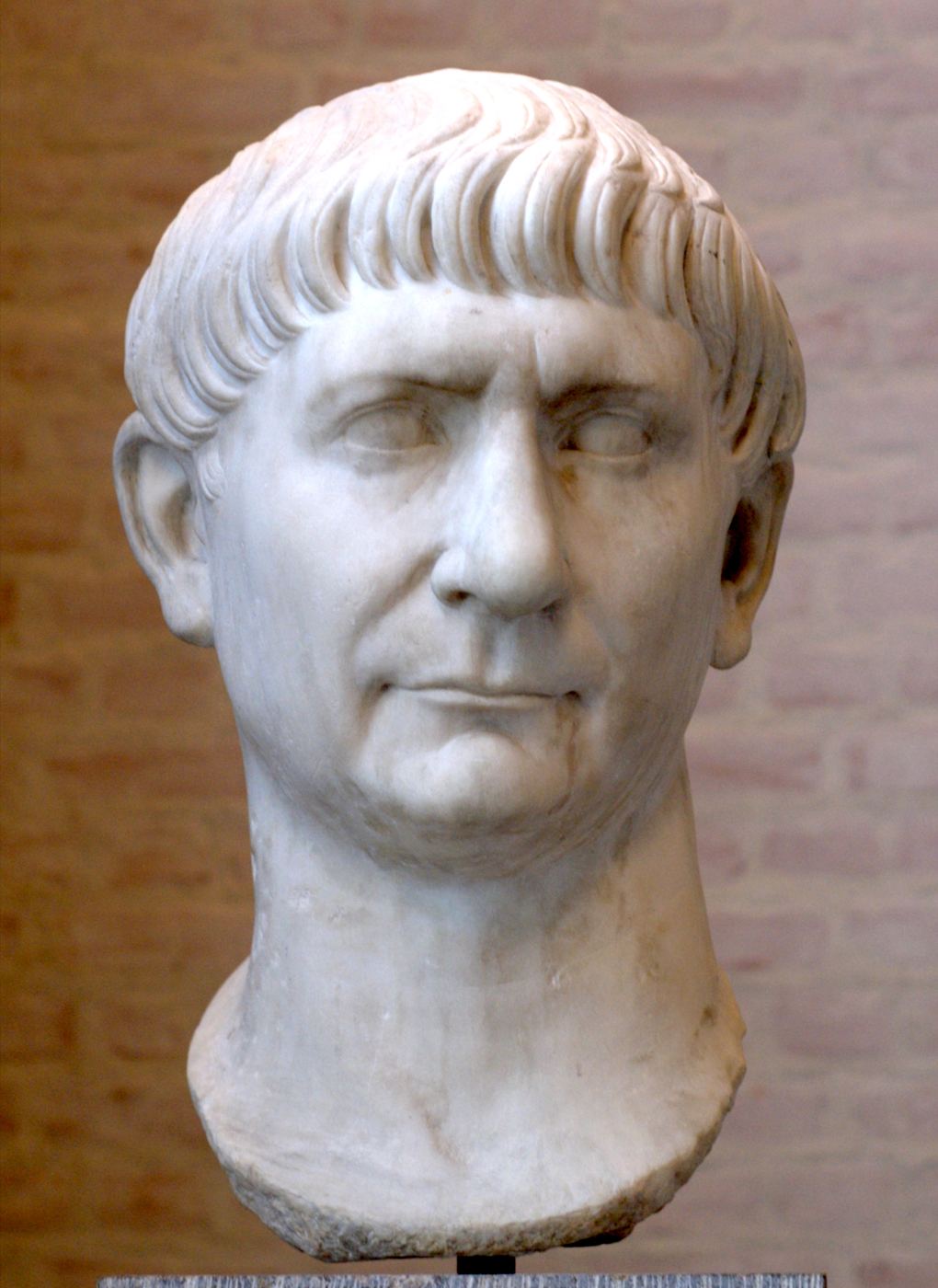
Marcus Ulpius Traianus was born on 18 September 53 CE in Italica, near modern Seville — the first emperor born outside Italy, a fact his contemporaries noted with fascination. His father, also named Marcus Ulpius Traianus, had been governor of Syria and a consul; the younger served under him in Syria as a military tribune around 75 CE, then commanded Legio VII Gemina in northern Spain. When the Rhine legions mutinied against Domitian's paranoid rule, marched swiftly from Spain to suppress them; Domitian's successor Nerva adopted him as co-emperor in 97 CE, recognising that only a man the army respected could stabilise the empire. Nerva died four months later and entered Rome in 99 CE to universal acclaim. He was forty-five. His first great military enterprise was the conquest of Dacia — modern Romania — a rich gold- and silver-mining kingdom that had humiliated Rome under Domitian. The First Dacian War (101–102 CE) ended with King Decebalus submitting and surrendering his weapons, but Decebalus rearmed, and crossed the Danube again in 105 CE. He built a monumental stone bridge across the Danube at Drobeta, designed by the Syrian engineer Apollodorus of Damascus, 1,135 metres long — still one of the largest bridges the Roman world ever constructed. After two years of brutal highland campaigning, Sarmizegetusa, the Dacian , fell; Decebalus cut his own throat rather than march in a Roman triumph. incorporated Dacia as a new Roman province in 106 CE, flooding it with settlers and opening its gold mines to imperial revenue. The spoils funded an extraordinary building programme in Rome itself. Apollodorus laid out 's Forum — the largest in the city, 300 metres long — anchored by the Basilica Ulpia and flanked by two libraries. At the forum's centre rose 's Column, dedicated in 113 CE, a 30-metre-tall marble drum wound with 2,662 carved figures depicting the Dacian Wars in a continuous spiral frieze. It is the most detailed surviving record of the Roman army in action and a work of art with no ancient parallel. Adjacent to the forum, 's Market — a six-storey complex of 150 shops and offices cut into the Quirinal Hill — was Rome's answer to a modern shopping centre and administrative hub. Beyond Rome, the Arch of at Beneventum (114 CE) commemorated his road-building in southern Italy, its reliefs among the finest of any surviving triumphal arch. In Spain, the granite Alcántara Bridge over the Tagus, dedicated in 106 CE, still carries traffic today. In 113 CE, launched his final campaign: the conquest of . He swept through Armenia, took Ctesiphon, the , and reached the Persian Gulf in 116 CE — the furthest east any Roman emperor would ever go. He gazed at the ships and said, reportedly, that he wished he were as young as Alexander. The eastern conquests proved impossible to hold; revolts broke out in his rear and his successor Hadrian would abandon them. died at Selinus in Cilicia on 9 August 117 CE, of a stroke, having never seen Rome again. His ashes were placed in the base of his Column. The Senate awarded him the posthumous title Optimus Princeps — the Best of Emperors — and for two centuries Romans swore by his memory.
All Figures
Roman Emperor · Conqueror of Dacia · Builder of Trajan's Forum and Column
Trajan
53 CE – 117 CE
The Spanish-born soldier-emperor who pushed Rome to its greatest territorial extent, conquered Dacia in two grinding campaigns, and left the capital transformed in marble and monumental stone.
Lifetime
Date source not yet attached to this catalogue record.
Deeper Dive
Unlock Trajan's full archive.
Notable works, life timeline, places lived, key quotes, reading list — all 158 figures' deep dives open with Epoch+.