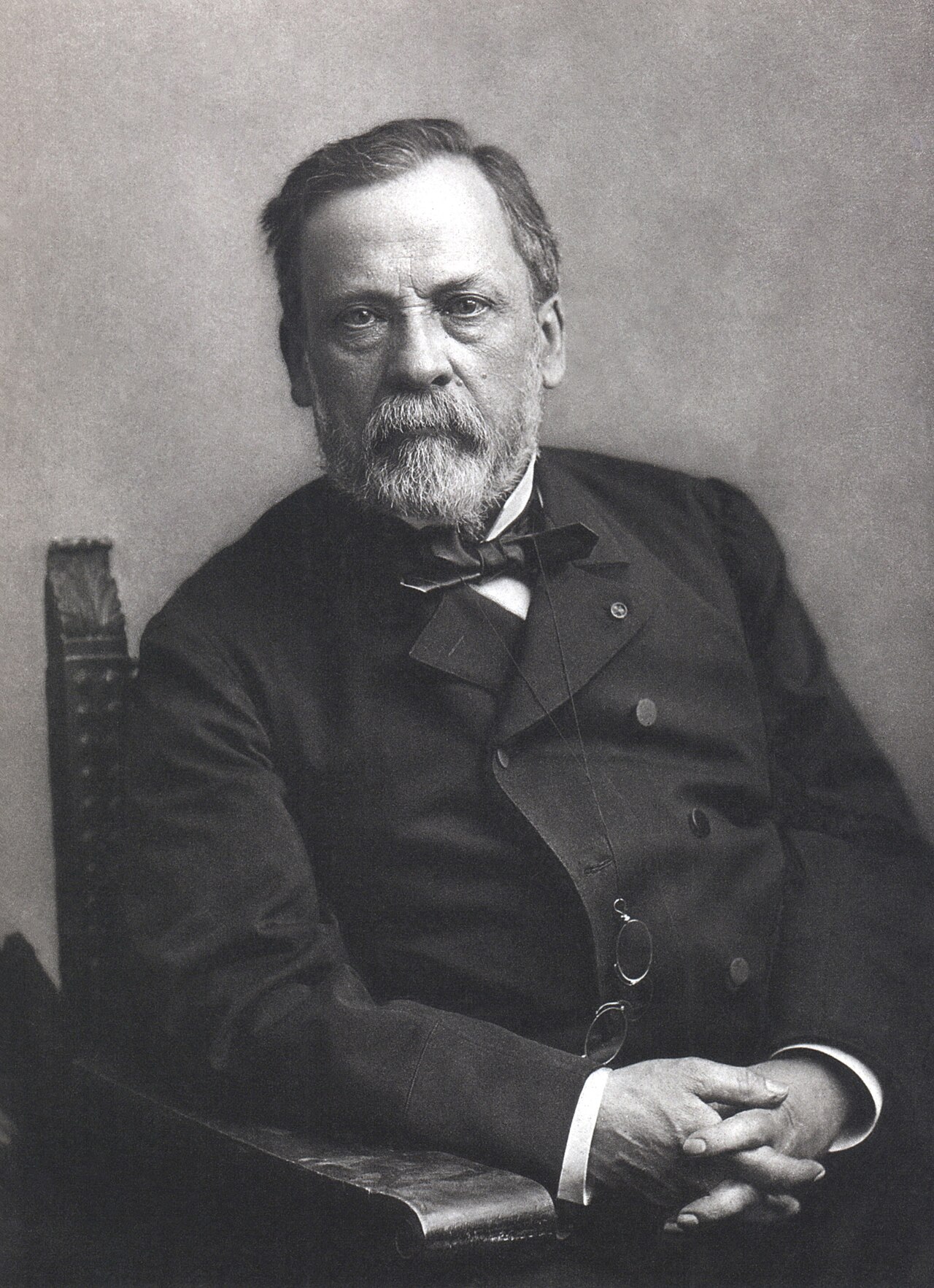
Louis Pasteur was born in Dole, France, in 1822, the son of a tanner. Trained as a chemist, he made his first major discovery at 26 — the molecular asymmetry of tartaric acid — but it was his work on fermentation in the 1850s that opened the modern era of biology. He proved that microorganisms cause both fermentation and disease, refuting the doctrine of spontaneous generation. His process for preserving food by gentle heating, 'pasteurisation,' is still in use. From 1879 to 1885 he developed vaccines for chicken cholera, anthrax (proved publicly at Pouilly-le-Fort in 1881), and rabies — the rabies vaccine, given to nine-year-old Joseph Meister in 1885, was the first vaccine for a human disease developed under modern principles. The Institut Pasteur, founded by public subscription in 1888, remains a leading centre of biomedical research.
All Figures
Chemist · Microbiologist · Father of Germ Theory
Louis Pasteur
1,822 CE – 1,895 CE
The French chemist who proved germs cause disease, invented pasteurisation, and developed vaccines for anthrax and rabies — saving an incalculable number of lives.
Lifetime
Date source not yet attached to this catalogue record.