Vladimir Ilyich Ulyanov was born on 22 April 1870 in Simbirsk, a provincial town on the Volga, the third of six children of a liberal schoolteacher who had risen to the hereditary nobility. His childhood was orderly and bookish until 1887, when his elder brother Alexander was hanged for plotting to assassinate Tsar Alexander III. Alexander's execution radicalised the seventeen-year-old Vladimir and set him on a path from which he never deviated. Expelled from Kazan University for participating in a student demonstration, he completed his law degree as an external student in 1891 and practised briefly before devoting himself entirely to revolutionary agitation. His early essays on Russian capitalism and the peasant economy earned him exile to Siberia (1897–1900), where he married Nadezhda Krupskaya and wrote 'The Development of Capitalism in Russia.' From Shushenskoye he planned the newspaper Iskra ('The Spark'), which he launched from Munich in 1900 and ran from London and Geneva, using it to forge a disciplined cadre of professional revolutionaries. 'What Is to Be Done?' (1902), written in Munich, argued that the working class could not spontaneously develop revolutionary consciousness and required a tight-knit vanguard party to lead it — the theoretical foundation of Leninism. At the 1903 Brussels-London congress of Russian Social Democrats the party split irrevocably between his Bolsheviks ('majority') and the Menshevik ('minority') faction, over precisely this question of party organisation. He spent the 1905 Russian Revolution in Geneva, arrived in St Petersburg too late to direct events, and returned to exile in Paris and then Cracow, where he wrote voluminously — ', the Highest Stage of Capitalism' (1916), drafted in Bern libraries during the First World War — while maintaining contacts with underground networks inside Russia. The February Revolution of 1917, which toppled the tsar, caught him in Zürich. He negotiated passage home through Germany in a sealed train, which the German government facilitated, hoping his presence in Russia would accelerate its collapse. He arrived at the Finland Station in Petrograd on 3 April 1917 and immediately delivered what became the April Theses: no support for the Provisional Government, immediate transfer of power to the soviets, no support for the war. The slogan 'All power to the Soviets' became the Bolshevik rallying cry. Through the summer of 1917 he survived an attempt to arrest him, hid briefly in Finland, and returned to Petrograd in October. On the night of 25–26 October (7–8 November by the new calendar) Bolshevik forces occupied the key points of the city; the Winter Palace fell, and Lenin announced to the Second All-Russian Congress of Soviets: 'We shall now proceed to construct the socialist order.' The civil war that followed lasted until 1922 and cost an estimated seven to twelve million lives. The Treaty of Brest-Litovsk (March 1918), negotiated partly by Trotsky, surrendered vast territories to Germany to buy Russia out of the war — a decision Lenin forced through against fierce internal opposition. After an assassination attempt in August 1918 that left a bullet in his shoulder, Lenin drove the Red Terror, the Cheka, and the collectivisation of grain that caused famine in 1921. The New Economic Policy (NEP), announced in 1921, partially restored market mechanisms to rescue the economy. A series of strokes beginning in May 1922 progressively disabled him. His final political act was the 'Testament' of December 1922–January 1923, a dictated series of notes that warned the party against Stalin, who had 'concentrated enormous power in his hands and I am not sure that he always knows how to use it with sufficient caution,' and suggested removing him as General Secretary. The Communist Party suppressed the document for decades. Lenin died on 21 January 1924 at Gorki, aged fifty-three. Against the explicit wishes of Krupskaya, the Politburo — led by Stalin, Zinoviev, and Kamenev — had his body embalmed and displayed in a granite mausoleum on Red Square, where it remains.
All Figures
Founder of the Soviet State · Leader of the October Revolution
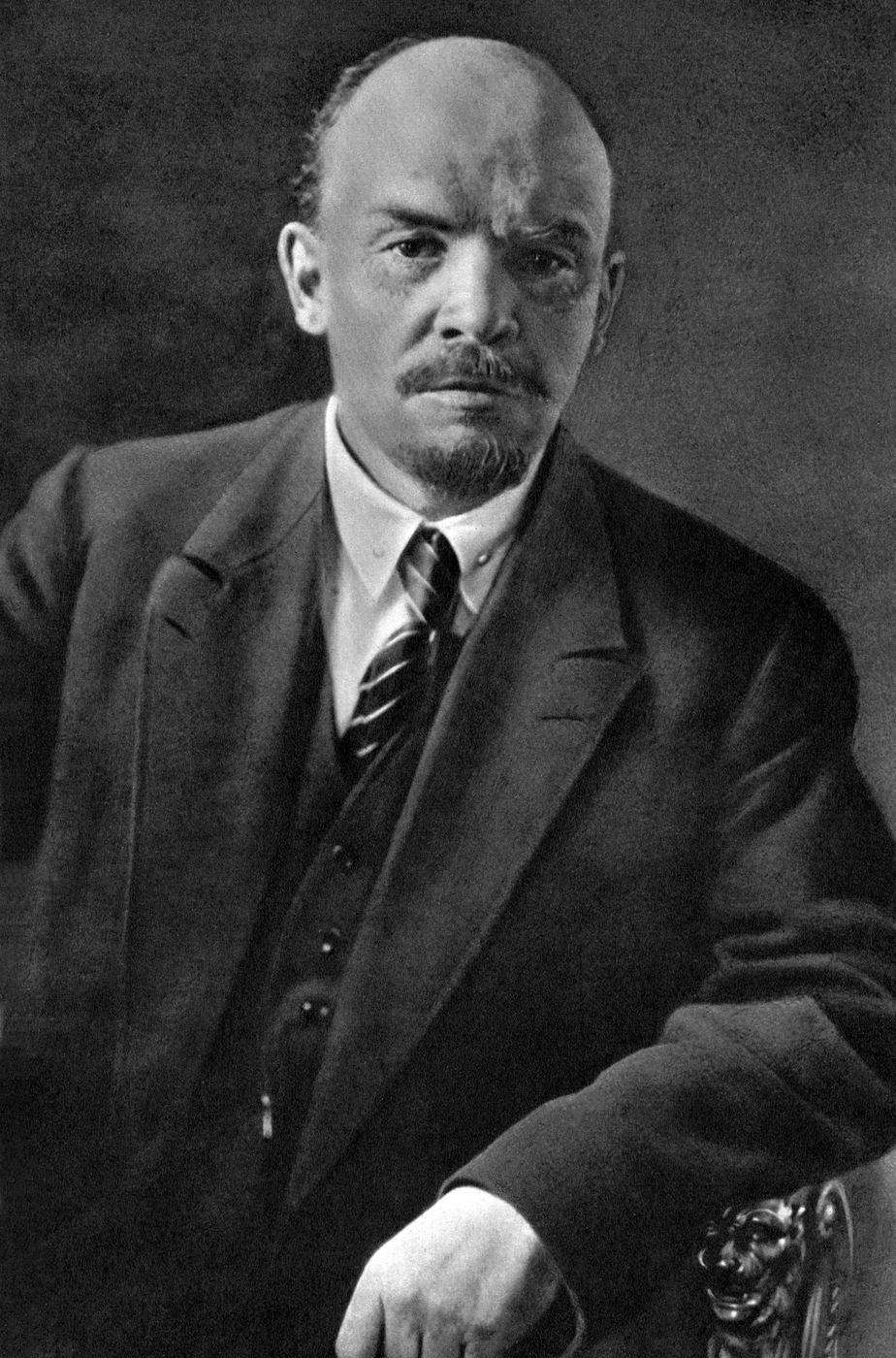
Vladimir Lenin
1,870 CE – 1,924 CE
The Marxist intellectual from Simbirsk who engineered the 1917 Bolshevik seizure of power, built the world's first communist state, and set in motion a century of revolutionary politics.
Lifetime
Date source not yet attached to this catalogue record.
Deeper Dive
Unlock Vladimir Lenin's full archive.
Notable works, life timeline, places lived, key quotes, reading list — all 158 figures' deep dives open with Epoch+.