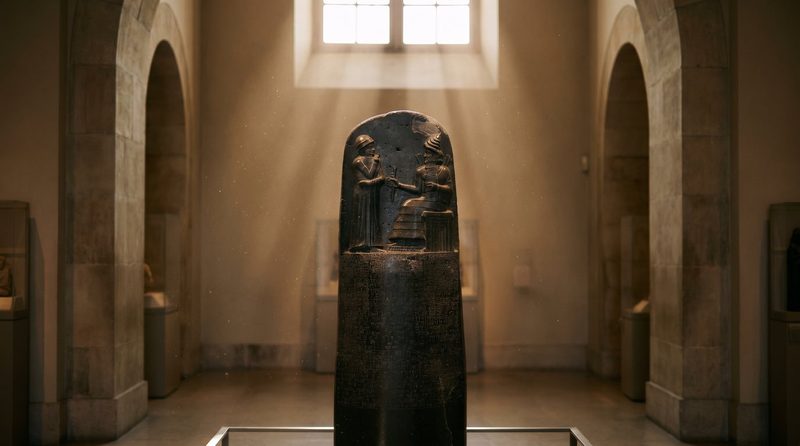
Hammurabi inherited the throne of Babylon in 1792 BCE — a small Amorite city among many in southern . Over forty-three years he conquered or annexed Larsa, Eshnunna, Mari, Elam, and Assyria, forging the first true Babylonian Empire. But what carried his name across millennia was not war: it was law. Around 1754 BCE he had 282 statutes carved onto a 7-foot column of black diorite, topped by a relief of the king receiving the laws from Shamash, god of justice. The stele covers commerce, family, slavery, surgery, agriculture, and crime — the first surviving code in human history to address an entire society at once. ("an eye for an eye") is its most famous phrase, but the same code also protects widows, orphans, and slaves; sets fixed wages; and binds the king himself to the rule of law. Looted by Elamites around 1158 BCE, the stele lay buried at Susa for nearly three thousand years until French archaeologists rediscovered it in 1901. It now stands in the Louvre.
All Figures
King of Babylon
Hammurabi
1,810 BCE – 1,750 BCE
Author of one of history's earliest legal codes.
Watch the 48s episodeLifetime
Date source not yet attached to this catalogue record.
Epoch Episode · ~48s
Epoch Episode · 6 scenes · ~48sEpoch+
