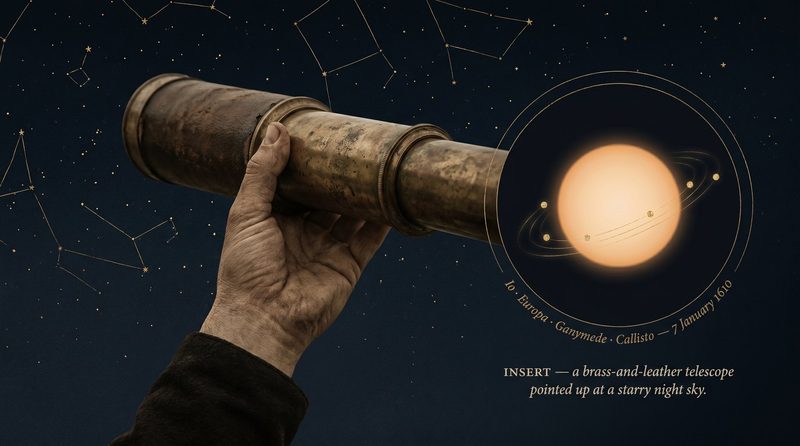
Galileo Galilei was born in Pisa in 1564, the same year as Shakespeare and the year Michelangelo died. Trained briefly in medicine, he turned to mathematics and at twenty-five was appointed to the chair of mathematics at the University of Pisa. By the early 1600s he had improved Dutch designs for the telescope into instruments thirty times more powerful, and across the winter of 1609–10 he turned them on the night sky. He saw mountains on the Moon, four moons orbiting Jupiter (still called the Galilean moons), the phases of Venus, the rings of Saturn, sunspots — and he understood, immediately, that what he was seeing made Copernicus right. The Sidereus Nuncius (Starry Messenger, 1610) made him famous. Twenty-three years later, in 1633, the Roman Inquisition tried him for arguing that the Earth orbited the Sun; under threat of torture he abjured the heliocentric position (and according to legend muttered — 'and yet it moves' — as he rose). He spent the last nine years of his life under house arrest at his villa in Arcetri, where, blind in his last years, he completed the Two New Sciences (1638), the foundation of modern dynamics. The Catholic Church formally apologised to him in 1992.
All Figures
Astronomer · Physicist · Engineer
Galileo Galilei
1,564 CE – 1,642 CE
The Tuscan polymath who built better telescopes than anyone in Europe, saw the moons of Jupiter and the phases of Venus, and was placed under permanent house arrest for saying — correctly — that the Earth moves.
Watch the 48s episodeLifetime
Date source not yet attached to this catalogue record.
Epoch Episode · ~48s
Epoch Episode · 6 scenes · ~48sEpoch+

Deeper Dive
Unlock Galileo Galilei's full archive.
Notable works, life timeline, places lived, key quotes, reading list — all 158 figures' deep dives open with Epoch+.