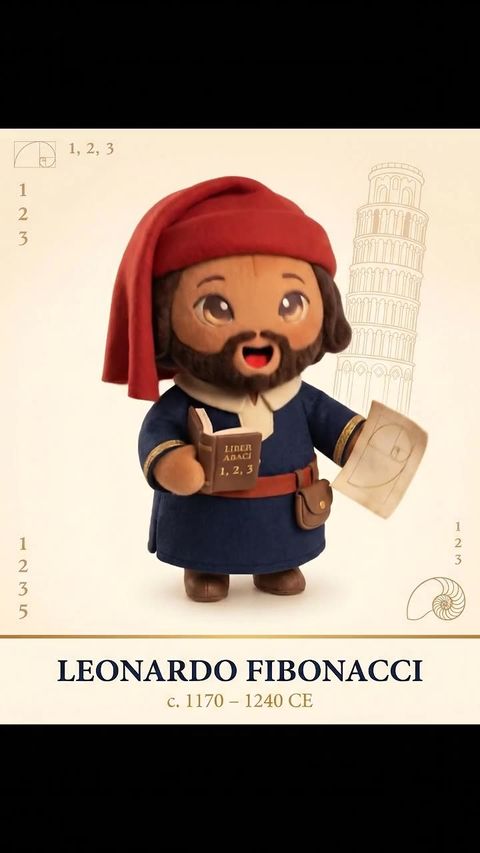
Leonardo Bonacci — Fibonacci, 'son of Bonacci' — grew up in Pisa's customs house in Bugia (modern Béjaïa, Algeria), where his father served as customs official to the Pisan trading colony. He learned the Hindu-Arabic numerals from his Arabic-speaking teachers and travelled the Mediterranean — Egypt, Syria, Greece, Sicily, Provence — collecting their mathematics. In 1202 he published the Liber Abaci, a 459-page book that introduced the digits 0–9 and the decimal place-value system to merchants of Latin Europe (who had until then used Roman numerals). The book solved problems in commercial arithmetic, currency conversion, and bookkeeping — and contained, almost in passing, the rabbit problem that produces the sequence 1, 1, 2, 3, 5, 8, 13… that bears his name. Within two centuries Italian merchants had adopted his numerals; within four they had displaced Roman numerals in every Western counting house. Modern algorithms still call subroutines on functions that begin where his rabbits did.
All Figures
Mathematician · Translator of Indo-Arabic numerals
Leonardo of Pisa (Fibonacci)
c. 1,170 CE – 1,250 CE
The Pisan merchant's son who travelled the Mediterranean, learned algebra in Bugia, and brought Indo-Arabic numerals to Europe in a single 1202 textbook.
Lifetime
Date source not yet attached to this catalogue record.