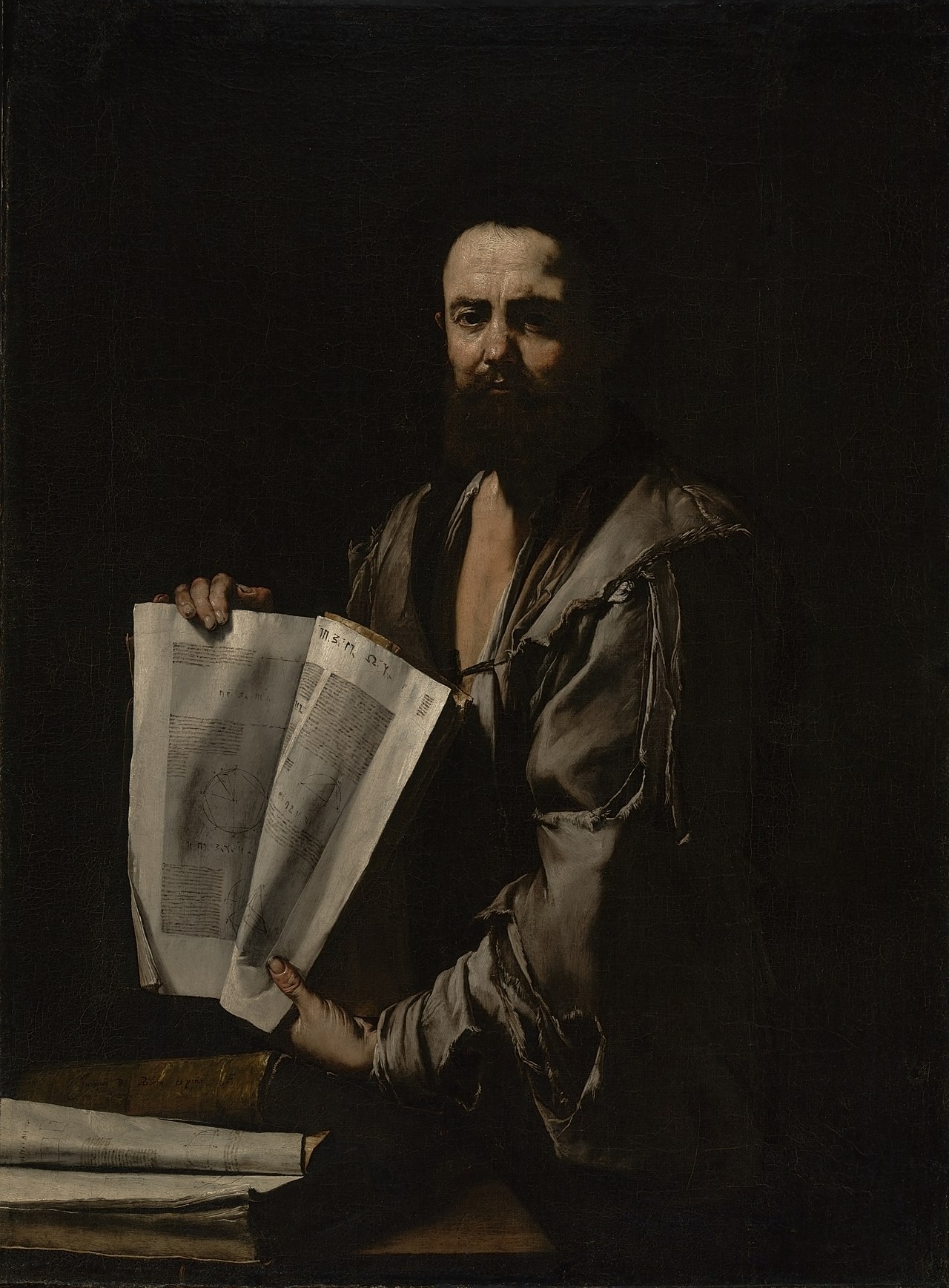
Euclid lived and taught at the Library of Alexandria during the reign of Ptolemy I, in the third century BCE. Almost nothing of his personal life is recorded — even the city of his birth is unknown. What survives, the Elements, is the most influential textbook ever written: thirteen books that derive plane geometry, solid geometry, number theory and the theory of irrational quantities from a handful of axioms and postulates, by purely deductive reasoning. Until the nineteenth century, every educated European read Euclid; Lincoln carried a copy in his saddlebags. Non-Euclidean geometries — the work of Gauss, Bolyai, Lobachevsky and Riemann — only became possible because his postulates had been stated so precisely that they could be challenged. Einstein later said that anyone who failed to be inspired by the Elements as a teenager was not destined for original scientific work.
All Figures
Mathematician · Author of the Elements
Euclid
c. 325 BCE – 265 BCE
The Alexandrian geometer whose thirteen books, the Elements, organised mathematics into deductive proof — and remained the standard textbook for two thousand years.
Lifetime
Date source not yet attached to this catalogue record.