Albert Einstein was born to a Jewish electrical-engineer family in Ulm in 1879. Slow to talk as a child, he was bored by Munich Gymnasium and dropped out at fifteen, finished school in Aarau, and graduated from the Zürich Polytechnic in 1900 with no academic post. From 1902 he supported himself as a Technical Expert (Class III) in the Swiss Patent Office in Bern. In his 'miracle year' of 1905 he published four papers that would have made any one of them a Nobel-worthy career: on the photoelectric effect (which won him the Nobel in 1921 and founded quantum theory); on Brownian motion (which proved atoms are real); on special relativity (which abolished absolute space and time); and on E=mc² (which made energy and matter the same thing). For the next decade he reached for the harder problem: gravity. In November 1915, after eight years of false starts, he wrote down the field equations of General Relativity — a theory in which gravity is not a force but the curvature of spacetime itself by mass and energy. Arthur Eddington's 1919 solar-eclipse expedition confirmed the prediction; Einstein became the most famous scientist in the world overnight. He left Germany for Princeton's Institute for Advanced Study in 1933 as the Nazis came to power, signed the 1939 letter to Roosevelt that started the (a decision he later called his greatest mistake), spent his last decades searching unsuccessfully for a unified field theory, and died of an aortic aneurysm in Princeton in 1955 at seventy-six. His brain was removed without permission and is still in scientific custody. General relativity has not yet been broken.

All Figures
Physicist
Albert Einstein
1,879 CE – 1,955 CE
Developed relativity; reshaped physics.
Watch the 48s episodeLifetime
Date source not yet attached to this catalogue record.
Epoch Episode · ~48s
Epoch Episode · 6 scenes · ~48s
0.0s / 48s
▸Voice-over arc · Read the script
- S01"Ulm, Germany, eighteen-seventy-nine. A boy named Albert Einstein is born."
- S02"Nineteen-oh-five. A clerk in Bern publishes four papers in one year."
- S03"Energy equals mass times the speed of light, squared."
- S04"Nineteen-fifteen. General relativity. Gravity is the curvature of spacetime."
- S05"The Nobel comes. The world watches the eclipse confirm his vision."
- S06"He dies in nineteen-fifty-five. His equations still open every door we walk through."
Deeper Dive
Notable Works

Annalen der Physik — table of contents, 1905
1905
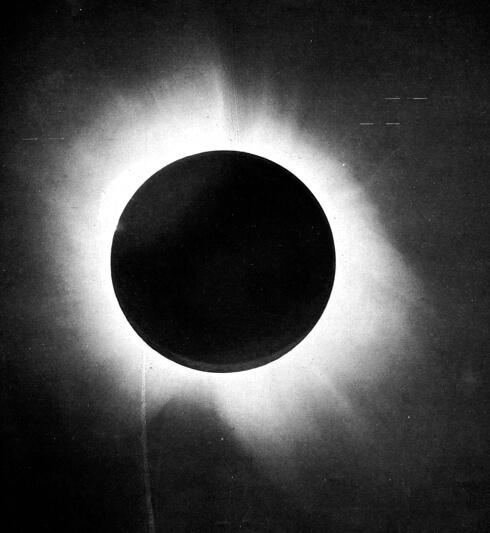
Eddington's 1919 eclipse plate — proof of general relativity
1919

Einstein's blackboard, Oxford lecture
1931

Einstein's letter to FDR warning of nuclear research
August 1939

The famous tongue photo (Arthur Sasse, AP)
1951

Einstein, age three
1882
Places
- UlmGermanyBirthplace. The family leaves within a year.1879
- MunichBavaria, GermanyChildhood and early schooling at the Luitpold Gymnasium, which he detested.1880–1894
- ZurichSwitzerlandFederal Polytechnic; trained as a physics and mathematics teacher.1896–1902
- BernSwitzerlandSwiss Patent Office clerk. Composed the four 1905 papers during evenings here.1902–1909
- BerlinGermanyDirector of the Kaiser Wilhelm Institute for Physics; completed general relativity here.1914–1933
- PrincetonNew Jersey, USALifetime post at the Institute for Advanced Study. Walked to work each day in the same grey jacket and no socks.1933–1955
In Their Own Words
Imagination is more important than knowledge. Knowledge is limited; imagination encircles the world.
God does not play dice with the universe.
The most incomprehensible thing about the universe is that it is comprehensible.
Try not to become a man of success, but rather try to become a man of value.
I have no special talents. I am only passionately curious.
Read Deeper
- Einstein: His Life and Universe2007by Walter IsaacsonBiography
- Subtle Is the Lord: The Science and the Life of Albert Einstein1982by Abraham PaisScientific biography
- The Meaning of Relativity1922by Albert EinsteinPrimary source
- Einstein's Cosmos2004by Michio KakuPopular science