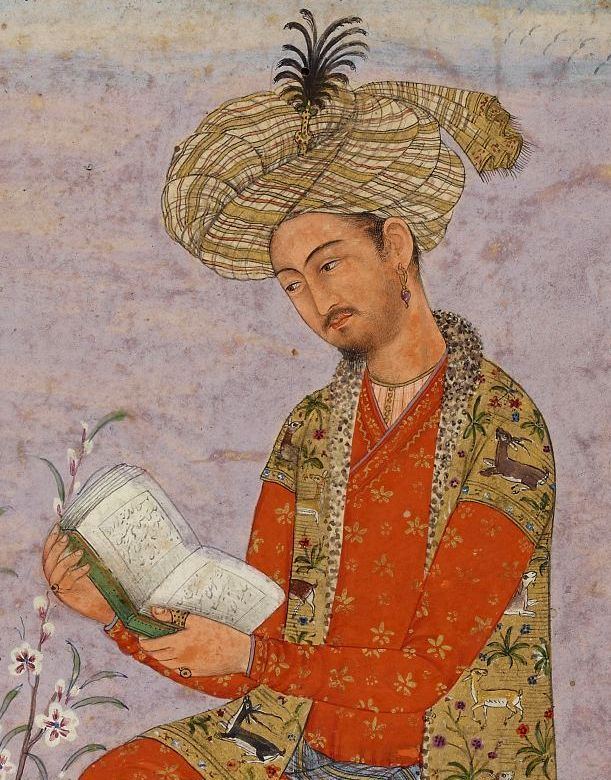
Zahir-ud-Din Muhammad Babur was born on 14 February 1483 in Andijan, in the Fergana Valley — a principality then ruled by his father Omar Sheikh Mirza, a minor Timurid prince. On his father's side he was a direct male-line descendant of Timur; on his mother's side, through the Chagatai line, he was descended from Genghis Khan. He united in one person the two supreme claims to Central Asian legitimacy — Timurid refinement and Mongol imperial blood — and that double inheritance defined his ambitions from childhood. He grew up in the Fergana Valley surrounded by the fragmented courts of his Timurid cousins, each governing a small city-state and fighting the others. When his father Omar Sheikh Mirza died on 8 June 1494 — falling with his pigeon-house into a ravine, Babur records without sentiment — Babur became king of Fergana at the age of eleven. What followed was nearly two decades of extraordinary reversals of fortune. He captured Samarkand, the Timurid ancestral and the most coveted city in Central Asia, three times: briefly in 1497, again in 1500, and a third time in 1511. He lost it each time — twice to the Uzbek conqueror Muhammad Shaibani Khan, who in 1500 had already destroyed the last organized Timurid resistance, killed several of Babur's cousins, and forced Babur's elder sister Khanzade into his own harem as a concubine. After his second loss of Samarkand at the Battle of Sar-e-Pol in 1501 Babur was left without a throne, wandering in the mountains above Samarkand with a handful of followers, surviving a Central Asian winter with no settled base. He recaptured Kabul in October 1504 by a surprise march across the Hindu Kush, and the city became the base he would hold for the next twenty-two years. The loss of Central Asia to the Uzbeks was permanent. Babur pivoted south and east. From Kabul he conducted four increasingly probing raids into the Punjab between 1519 and 1524, studying the defenses of the Lodi Sultanate of Delhi and making contact with disaffected Afghan nobles. The invitation came in 1525: Daulat Khan Lodi, governor of the Punjab, offered his allegiance if Babur would invade. At the First Battle of Panipat on 21 April 1526, Babur's force of roughly 12,000 men — equipped with -trained artillery under Ustad Ali and Mustafa Rumi and using the 'cart-and-cannon' tulughma formation — defeated Ibrahim Lodi's army of perhaps 100,000 and 1,000 war elephants. Ibrahim Lodi died on the field; Babur entered Delhi and Agra and founded the dynasty that would rule northern India for over three centuries. He consolidated control at the Battle of Khanwa in March 1527, defeating the Rajput confederacy under Rana Sanga; at the Battle of Chanderi in January 1528; and at the Battle of the Ghaghra in May 1529, where he crushed the last major Afghan coalition. He died in Agra on 26 December 1530, aged forty-seven, reportedly after performing a circuit of his son Humayun's sickbed and praying that God take his life in exchange for the prince's recovery. Humayun recovered; Babur died within days. His body was eventually returned to Kabul and interred in the Bagh-e Babur, the formal garden he had designed himself, on a hillside with a view of the city he loved more than any place in India. Beyond conquest, Babur was a writer of rare frankness and precision. The Baburnama — completed in Chagatai Turkic, the prestige literary language of the Timurid world — is the first true autobiography in Islamic literature, and one of the most distinctive memoirs in world literature: a soldier-prince recording his losses and his loneliness with the same exactness he brought to descriptions of Afghan flowers, Indian birds, and the quality of Ferghana's melons. He was also a poet of the Chagatai school, a designer of the formal four-part charbagh garden, and a keen botanist — his observations on Indian flora and fauna in the Baburnama remain a scientific source.
All Figures
Founder of the Mughal Empire in India · Poet and Memoirist
Babur
1,483 CE – 1,530 CE
Timur's great-great-grandson who lost Central Asia, won India with a handful of men and artillery, and wrote the most vivid autobiography of the medieval world.
Lifetime
Date source not yet attached to this catalogue record.
Deeper Dive
Unlock Babur's full archive.
Notable works, life timeline, places lived, key quotes, reading list — all 158 figures' deep dives open with Epoch+.