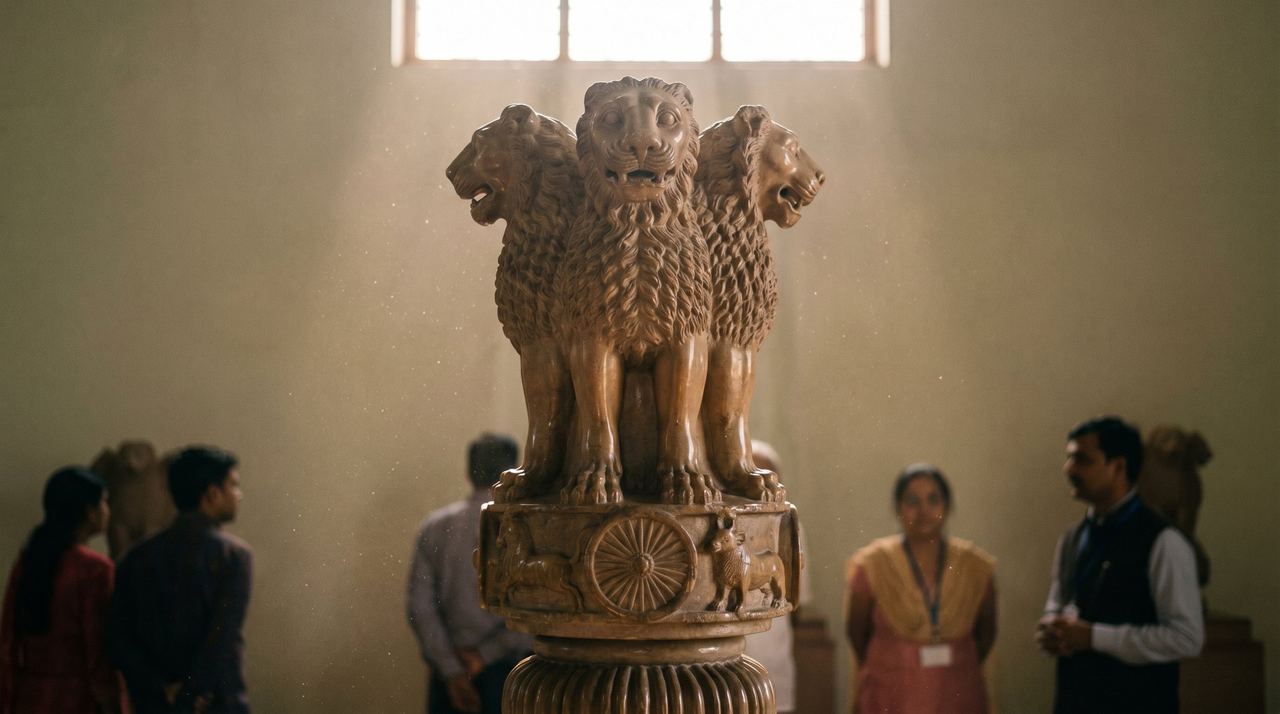
Ashoka was born around 304 BCE, grandson of Chandragupta, founder of the Empire that had unified most of the Indian subcontinent. He came to power around 268 BCE through what the chronicles describe as a violent succession. For the first decade of his reign he was a conqueror in the family tradition; in 261 BCE he invaded the kingdom of Kalinga (modern Odisha) and won — at the cost of perhaps a hundred thousand dead and a hundred and fifty thousand displaced. Walking the field afterwards he is said to have wept, and turned. From that point until his death thirty years later he ruled the largest empire ever assembled in South Asia not by the sword but by Dhamma — a public ethics of nonviolence, religious tolerance, animal welfare, and care for the poor, the elderly, and prisoners. He inscribed thirty-three of these edicts onto rock faces and free-standing sandstone pillars across his realm, from Afghanistan to Andhra Pradesh; many still stand. His missions sent his son Mahinda to Sri Lanka, carrying Buddhism beyond India for the first time. He died around 232 BCE. The four-headed lion that crowned his pillar at Sarnath, with the wheel of the Dhamma between its paws, is today the national emblem of the Republic of India; the wheel is on the centre of its flag.
All Figures
Mauryan Emperor · The Conqueror Who Wept
Ashoka the Great
c. 304 BCE – 232 BCE
The Mauryan emperor who turned from butchery to the Buddha — and carved compassion into stone.
Watch the 48s episodeLifetime
Date source not yet attached to this catalogue record.
Epoch Episode · ~48s
Epoch Episode · 6 scenes · ~48sEpoch+