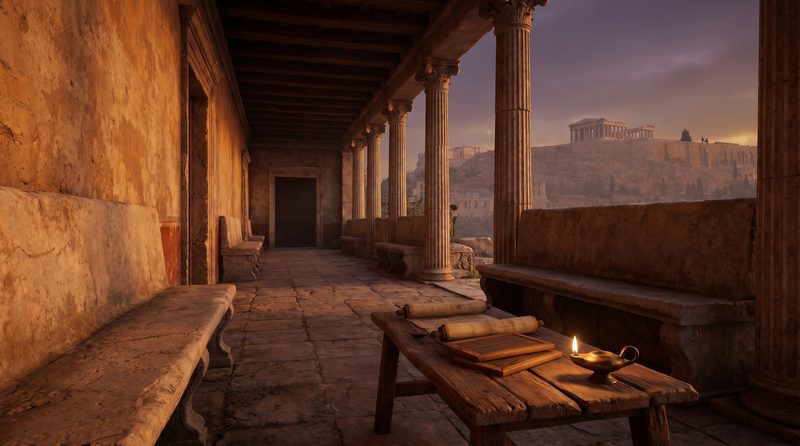
Aristotle was born in 384 BCE in Stagira, a small Greek-speaking town on the coast of Chalkidiki, the son of Nicomachus, court physician to the kings of Macedon. He went up to Athens at seventeen and entered Plato's Academy, where he stayed for twenty years — first as student, eventually as teacher — until Plato's death in 347. Refused the leadership of the Academy, he left Athens, married into the dynastic family of the tyrant Hermias of Atarneus, and was hired in 343 by Philip II of Macedon to tutor his son Alexander, then thirteen. Returning to Athens around 335 he founded his own school, the Lyceum, in a grove sacred to Apollo Lyceus. The Peripatetic philosophy that took its name from his habit of walking while teaching produced — across the next twelve years — the corpus that single-handedly invented Western logic (the Organon), the foundational texts of biology, the first systematic ethics (the Nicomachean Ethics), the first comparative political science (the Politics), the first surviving treatise on poetics, and a metaphysics whose categories of substance, accident, potency and act would frame all Christian, Islamic, and Jewish thought. On Alexander's death in 323 anti-Macedonian sentiment forced Aristotle to flee Athens — 'lest the Athenians sin twice against philosophy', he is said to have remarked, with reference to Socrates. He died the following year on Euboea at sixty-two.
All Figures
Philosopher · Polymath · Founder of the Lyceum
Aristotle
384 BCE – 322 BCE
The Macedonian-born polymath who tutored Alexander, founded the Lyceum, and divided knowledge into the categories we still use today.
Watch the 48s episodeLifetime
Date source not yet attached to this catalogue record.
Epoch Episode · ~48s
Epoch Episode · 6 scenes · ~48sEpoch+
Deeper Dive
Unlock Aristotle's full archive.
Notable works, life timeline, places lived, key quotes, reading list — all 158 figures' deep dives open with Epoch+.